
I’m sitting on the dock of the bay. Technically it is a bench on Exeter Quayside in England, but I’m in a mellow mood on this sultry Sunday afternoon, watching the canoes and swans roll away along the River Exe.
One of the things I’ve really enjoyed about our nomadic lifestyle has been the freedom to explore my own country. We do travel further afield too, but it has been a great opportunity to get to know parts of the UK I have never really experienced before.

Exeter has been a particular treat, with the vibrant quayside, impressive cathedral and architecture, and its long history reflected in a range of curious local landmarks.
There are undoubtedly many things I could write about Exeter, but I thought I might pen the story the story of a very curious Exeter landmark I only discovered existed a few days ago, It is the story of a mild political satire, thwarted opportunism, and an historical England-Germany tussle (that may yet still have life in it)!
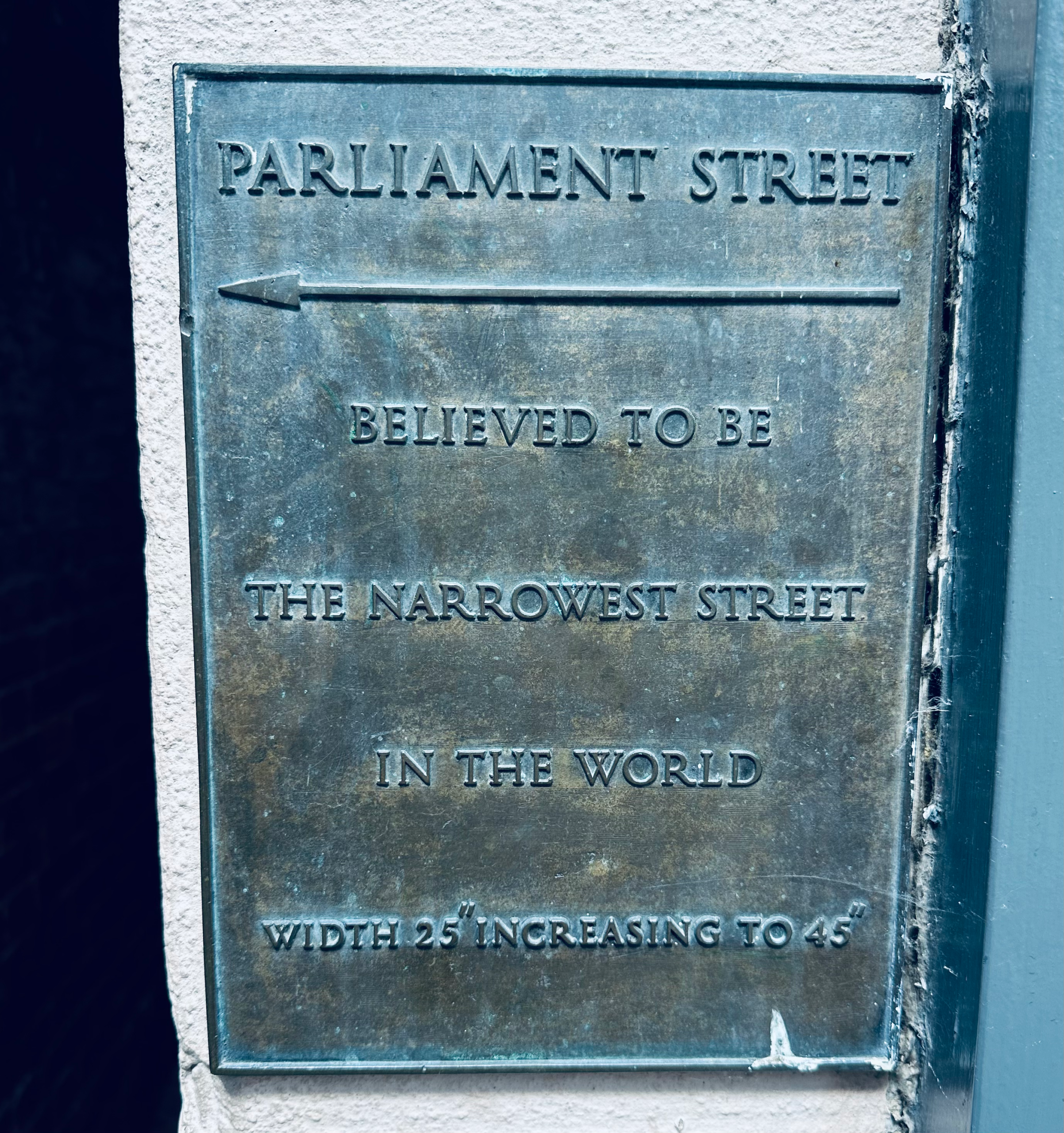
We are currently house sitting near the centre of Exeter for a few weeks and yesterday I decided to take a wander around the city centre (wandering idly around new places being my default these days). Walking along the High Street, I chanced upon an unassuming metal plaque attached to the side of a Greggs bakery shop. The plaque made the bold claim:
PARLIAMENT STREET
BELIEVED TO BE
THE NARROWEST STREET
IN THE WORLD
Proud Exonians no doubt know all about the ostentatiously named “Parliament Street”. However, as a first time visitor to Exeter, it wasn’t something I’d come across before. I was intrigued to find out more.
The Narrowest Street in the World?
This narrow two foot gap currently separates the Greggs shop from a disused vape shop next door. Even with the modest “believed to be” caveat, it was still a bold claim. One that sparked a number of questions. Who was it that “believed” it “to be the narrowest street”? Could this small gap even be classified as a street? And, of course, the primary question was:
Was it really the Narrowest Street in the World?

It was certainly narrow. Slightly wider than shoulder width as I walked the length of it. (It seemed the appropriate thing to do). According to the plaque, it is specifically 25 inches (63.5 cm) wide at High St, widening to 45 inches (114cm) at the other end (50 feet/15m away).
I was pretty sure that I had squeezed along small alleys or paths in various other parts of the world that were similarly narrow though.
I was more than a little dubious about the claim and decided to retire to pursue the answers to my questions at my (now) favourite Exeter deli, How On Earth on South Street. Over a generous plant-based toasted focaccia, I set to work on my research, aka browsing on my phone.
It didn’t take me long to find that my initial scepticism over the “narrowest” claim was valid, but not for the reasons I had thought.
I assumed there must be some legal definition that defined what a street is, as compared to an alley or simply a gap between two buildings. However, it seems that there isn’t, in UK Law at least, where a street is broadly defined as “any highway . . . and any public bridge . . . and any road lane footway square court alley or passage whether a thoroughfare or not”.
However, it turns out that the folks who spend all their time recording world records, the Guinness World Records, do have a definition for a ‘street’. That definition rules out a plethora of narrow gaps and passageways around the world that don’t meet their strict criteria.
Parliament Street does in fact meet their criteria, but disappointingly for Exeter, (and the pride of England), so does the much narrower street of Spreuerhofstrasse in Reutlingen, Germany.
Spreuerhofstrasse, with a maximum width of 20 inches (50cm) was officially declared the world’s narrowest street by the Guinness World Records in 2006.
So that was it. The question of the narrowest street record was resolved. However, there were still plenty of other unresolved questions in my mind. It seemed to me that Parliament Street had more of a story to tell than just being the second narrowest street in the world.
I decided to head home to continue my research in earnest.
What The Plaque Doesn’t Tell You
After a fascinating 24 hours wading through the history and idiosyncrasies of Parliament Street, I’m now sitting on my quayside bench with a stack of research notes, eager to lay out the whole story.
The question that struck me was who was it that believed that Parliament Street was the narrowest street in the first place and why did they think that. i.e.:
Who put up the plaque?
It did take a bit of digging to discover the originators of the plaque. Contemporary sources post-2006 (local historians, content creators et al.) all accept that Parliament Street is not the world’s narrowest street and tend to focus on why it came to be so named, rather than pursue the reasons why anyone believed it was the narrowest in the first place.
In truth, the naming of “Parliament Street” is the more interesting story, but I think it is still worth taking a moment to examine the mounting of the plaque. I’ll come back to the mystery surrounding the name shortly.
The plaque was unveiled by the City Council in 1960. According to the local newspaper, this “thoroughfare” had been regarded as the narrowest street for a long time and they were sure “on the present available evidence” it could not be challenged by any other street’s claim to be the narrowest. The newspaper praised the council and, in particular, councillor W. A. Cox, the driving force behind putting up the plaque (Express and Echo, 13 April 1960, Page 4).
Initially I mused that councillor Cox probably didn’t try too hard to verify the record. No doubt thinking the claim would be a good draw for tourists. The local newspaper certainly thought so and praised the council for this piece of opportunistic civic enterprise.
Then I considered that it was another 46 years (into another century/millennium even) before the German street was awarded the record. Maybe Exeter could be forgiven for claiming the narrowest street accolade in the 20th century.
That got me thinking about what criteria Exeter council could have used to verify that they boasted the world’s narrowest street in 1960.
The Guinness Book of World Records had barely started by 1960. It didn’t have a narrowest street record or even the definition of what makes a “street” . Even if Spreuerhofstrasse is now the record holder by the Guinness criteria, could Parliament Street have been the narrowest by some other definition when the plaque was erected?
Measuring the width is straightforward and objective. Measuring is not the issue. What is obviously necessary, is to measure things that are comparable. In this case, a street. Is a street simply a ‘street’ because someone says it is. In which case, that begs the question:
Who designated Parliament Street a ‘street’?
The short answer to this question is that no-one knows.
The slightly longer answer brings us back to the naming of the street and the engaging story of an Exeter in-joke that has persisted for centuries.
The Naming of Parliament Street
The 1792 map of Exeter does show a lane between 194 and 195 High Street. The lane is not labelled, but it clearly runs the route of the present day Parliament Street. (The lane wasn’t labelled on any published map until 1970s, by which time it was called Parliament Street).
This small narrow lane isn’t shown on any published maps before 1792, but most likely that was because it was simply insignificant. There is evidence that it had existed for at least 400 years before then.

The first reference to a “small lane” near Waterbeer Street and High Street is recorded in two documents, from 1327 and 1383 respectively.
There is also an order in the 1740 City Council records that refers to “the little lane” (Exeter City Chamber Act Books, 1740 volume, 23 Dec 1740). This order required doors to be put up at either end of this lane, because locals were emptying their toilet waste into it.
(Slight confession. I’m painting an idyllic picture of scratching out a story by the riverside, with a cold drink in one hand and the results of just 24 hours of research in the other. That’s mostly true, but I did have to wait until midweek to confirm the 1740 order with the helpful folks at the Devon Heritage Centre, before adding to this final edit.)
The VisitExeter website confirms that the street was at least 14th Century and states that it was originally called “Small Lane”. There is no evidence for the latter, although locals could have referred to it as “Small Lane” because it was literally a small lane. (In a similar way that the adjoining street of Waterbeer Street was known as colloquially known as “Theatre Street” because there was a theatre on Waterbeer Street until 1787.)
I doubt that it was originally named anything though. What we have is an ancient, tiny cut-through between houses, too inconsequential to be named on any map. A redundant route, as it was far easier to get from High Street to Waterbeer Street using the Guidhall lane a few yards away (as it still is today, using the Guidhall shopping centre entrance). It was simply a narrow smelly passageway that no doubt was used as a dumping ground for much of its history.
And then someone decided to call it Parliament Street!
The Slim Joke
There are a number of Parliament Streets in England, in far more esteemed settings. Parliament Street in London, leading to the Houses of Parliament, being the principal example.
It is inconceivable that any one would name this dingy lane “Parliament Street” for innocuous reasons. It seems clear that the choice of name was a joke that somehow stuck.

What occurred to prompt such a ‘joke’ is unknown, but there are a few theories knocking around
One of the most popular theories is that it was related to the controversial overturning of an electoral reform bill by the House of Lords in October 1831. The populace were outraged. Riots broke out, including in Exeter where effigies were burned of the Bishop of Exeter, who had voted against the bill, and other local Exonian dignitaries.
The theory has potential. The earliest published reference to “Parliament Street” is November 1831, just a few weeks after the riots. The Western Times (Sat, Nov 26, 1831, Page 1) reports on an application to Parliament, including a reference:
to widen a certain passage called Parliament street. Leading from the High street into Theatre street
The report uses the familiar “Theatre street” (for Waterbeer Street, as mentioned earlier), so the reporter may well have been comfortable using the “Parliament Street” nickname too.
It does seem too soon for the joke to have taken off so quickly though. Either that, or the report (an otherwise relatively boring list of local improvements) was subtly promoting the joke at its inception.
We’re forced to imagine some bored, and/or subversive, lowly clerk writing up the report for unremarkable building work to be completed on the dingiest, narrowest lane in the city and, presumably sniggering to himself, labelling the lane as “Parliament Street”. It is possible, I suppose.
There are other theories for the naming. Another is that it was a snub to Cromwell and his Parliamentarians. Exeter suffered a great deal during the English Civil War, being captured first by the Royalist forces and then besieged by the Parliamentarians. As such, there would have been many Exonians who were not overly enamoured by the Commonwealth.
While it is not unfeasible that someone could have taken it into their head to rename the street as a mild insult to the 17th Century Parliamentarians, it seems a bit of a stretch to wait at least a hundred years to do it. As discussed, we know that the street wasn’t renamed until after 1740.
The true reason Parliament Street was named (sometime between 1740 and 1831) is lost in time, but I imagine the reason was more prosaic. The English rarely need much encouragement to critique ‘The Establishment’. I imagine the naming went something along the lines of:
First Guy: Look, that street is really narrow!
Second Guy: Yeah, you couldn’t pass anything along there
First Guy: Yeah. Just like our Parliament!
Second Guy: Woah! Political satire! We should call it Parliament St!
First Guy: Yeah, that’s funny. Ha Ha
And the name stuck.
It is a testament to the tenacity of the Exonian satirical spirit, that the name has stuck for two hundred years or more. That is really holding on to a joke.
Returning to The Definition of a Street
So, we can say Parliament Street was declared a street by some unknown jokers sometime after 1740 and officially recorded by at least 1831. As interesting as this historical detour is, it doesn’t change the fact that Spreuerhofstrasse was also officially declared a street by its council in 1820.
If we accept the simple definition:
a street is a street because it is called a “street”
Then, whether Exeter council knew it or not, in 1960, Spreuerhofstrasse was still the narrowest street in the world.
That definition seems a little amateurish though, and evidently the Guinness World Records agreed, creating their own definition of a street:
a ‘street’ or ‘road’ is defined as a public thoroughfare that is commonly used by the public who have a right of access to drive vehicles along it to get from one destination to another.
It should be noted that this definition was for the Steepest Street record (another hotly contested record between fierce rivals in Wales and New Zealand), but to be consistent GWR surely must define a ‘street’ the same for every type of street record?
By this definition, I would question whether Spreuerhofstrasse could really be considered a public thoroughfare suitable for vehicles. By all accounts it is difficult to even just walk/squeeze along it.
I just wonder whether the Parliament Street story has more road to tread? Perhaps the city of Exeter were too quick to block councillor Cox’s driving ambition and declare the world record claim a dead end. Maybe it is time to pave the way to a new claim? I’m making tracks tomorrow, heading for a new destination, so I’ll leave that with them, but I hope, in any case, that my meandering down the various avenues of the story has provided some insight into Exeter and this curious landmark.


